

Resources
Our Opinion / Experiences
Just sharing our thoughts, experiences and opinions. Never know when you can help another rider with information you thought everybody knew but didn't.
Click on pic for more info. Scroll down for links on various topics.
 |  |  |  |  |
|---|---|---|---|---|
 Screen Shot 2018-07-11 at 11.40.08 AM |  Screen Shot 2018-07-11 at 11.40.24 AM |  Screen Shot 2018-07-11 at 11.37.53 AM |  Screen Shot 2018-07-11 at 11.38.04 AM |  Screen Shot 2018-07-11 at 11.36.04 AM |
Screen Shot 2018-07-11 at 11.40.08 AM |  zx10rnijaadFor sale! Ninja zx10 as of 5/16/18 |  http://www.streetzdisciple.org/STREETZ DISCIPLE MM IS A FAITH-BASED MOTORCYCLE MINISTRY DRIVEN TO MAKE DISCIPLES OF OUR NATION ONE STREET AT A TIME. COMING TO A STREET NEAR YOU. |  Free Motorcycle Riding AssistanceClick link for more info. Great to have and it's FREE!! Sign up. |  Need patches stitched to your vest? |
 NJ Driving Points Systemnote 1/7 |  NJ Driving Points SystemNote 2/ 7 |  NJ Driving Points SystemNote 3/7 |  NJ Driving Points SystemNote 4/ 7 |  NJ Driving Points SystemNote 5/7 |
 NJ Driving Points SystemNote 6/7 |  NJ Driving Points SystemNote 7/7 |  NYC Motorcycle shopDec. 2nd Jacob Javits Center. Use promo code for $4 off your $20 ticket. Total is $17 (online $1fee). See you there around 10am! |  Winterize your motorcycleHow to winterize your motorcycle.. incase you don't plan on riding it :) |  jiffylubecouponjpg$10 off Car Oil change Expires April 2018 Enjoy. |
 App for bike ridesGoing to try this app this weekend 9/23/17 to see if it tracks my routes. Friends take me on great routes that i never remember so hoping this will help! I'll let you know :) Time to get lost!! |  lockedout |  track daySuzuki gsxr on track day - advice |  FlashingECU vs Power Commander convoConvo for Flashing your ECU vs using standard Power Commander ... The Power Commander is a fuel injection adjustment unit that plugs "inline" with the bike’s stock ECU (electronic control unit). The PC uses original equipment style connectors, so no splicing or cutting of the harness is required. Most installations take less than 15 minutes, some as little as 5 minutes. Changes are made to the bikes fuel and, in some cases, ignition curves via the PC's onboard microprocessor. |  Kawasaki Ninja 650Motorcycle Engine before installation |
 Kawasaki Ninja 650What does no engine in bike look like |  periodic maintenance chartperiodic maintenance chart for suzuki gsxr 600 |  10w40 oil changeThis is the motorcycle oil i use for 2011 Suzuki gsxr 600 - check your manual for your type. Walmart and auto stores carry it. I use close to 4 bottles |  Suzuki HayabusaWhat does work sprockets look like |  notarybb |
 andrw |  Bike shops NJWe are not supporting/saying what shop to use for your motorcycle but here's info for you to call and get price & more info for your bike. -Motorcycle shops NJ & NYC |  tiresGot at Walmart - Secaucus for $1.97 |  Winterize Motorcycle | 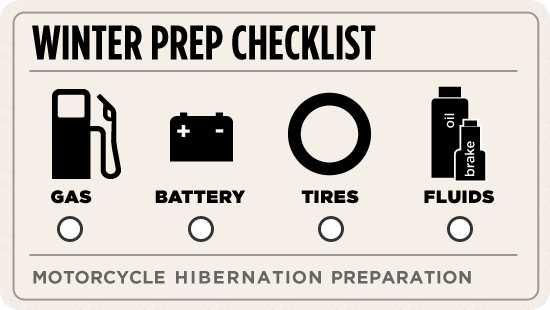 Winter prep listWinter prep list |
 Riding in the rainRiding in the rain |  Biker chickBiker chick |  advice |  Bikers toolsBikers tools |  WinterizeWinterize |
 Bike adviceBike advice |  torque it!! |  True story |  Haha!!Exactly! |  Good adviceGood advice |
Links/Blogs with how to info ...
click pic/quotation image

Motorcycle Plates Lost/Stolen/ Fell off the bike : Reporting lost or stolen plates
Replacements for lost or stolen license plates are issued at all motor vehicle agencies. If your plates were stolen, a report should be filed with local police.
For a vehicle currently in use
If one or both of your plates were stolen or lost, you must first obtain replacement plates at any local motor vehicle agency. Complete a Vehicle Registration/Plate Status Form (BA-1), at the agency, to report the plates as lost or stolen. This form marks the verification status. Save the verification in a safe place as proof that you notified the MVC.
To replace your damaged plates you must:
-
Visit any local MVC Agency
-
Present current registration certificate and required ID
-
Pay $6 fee for standard plates or $11 for special interest or dedicated plates
You will be issued a replacement set. You can surrender your old plates to any MVC Agency or Regional Service Center. Or you can mail the plates to:
Motor Vehicle Commission
Trenton Regional Service Center
P.O. Box 129
Trenton, New Jersey 08666-0129
Duplicate plates- You can request duplicate plates if one or both plates have been damaged.
To obtain duplicate plates with the same plate number, download form SPU-89 or visit your local MVC Agency or call the MVC at (609) 292-6500 extension 5061 to obtain an application (Form SPU-89) and a return envelope.
-
Return the application with a copy of your registration and an $11 check or money order
-
Duplicate plates will be sent to you through the mail in approximately 10 to 12 weeks. Please destroy or surrender the damaged plates to MVC when you receive your new ones
Note: If you surrender your plates, do not enter the plate number into MVCs computer system – let them know they are duplicates.
Lost or stolen plates - any plate number
To replace lost or stolen plates with new ones containing the next available number:
-
Make an official police report to the municipality where the plates were stolen and obtain a copy of the report for your record
-
Visit any MVC Agency and present the current registration certificate and proper identification
-
Pay $6 fee for standard plates or $11 for special interest /dedicated replacements
For a vehicle no longer owned by you
Notify the MVC in writing. Provide a signed statement describing what happened; include a police report if your plates were stolen. Be sure to include your name, mailing address and license plate number. Mail to:
Motor Vehicle Commission/ Customer Advocacy Office
P.O. Box 403, Trenton, NJ 08666-0403
You will receive verification of the updated license plate status in the mail. Save the verification in a safe place as proof that you notified MVC.
They Stole my license plate! WTF
NJ what to do with lost/stolen license plate
Can I leave my bike out in the rain?
Answers:
-Leaving it in the rain causes the color to fade, certain parts to rust, and it's not good for your chain after considerable amount of time in the rain.
- it will start to rust if you keep it outside consistently, best to keep it inside as much as possible if able.
- If you have ever dropped your bike and obtained scratches in your exhaust, that will rust if it is left in the rain or condensation. Also its not good for your chain.
-Just throw a cover on it and you'll be fine. Make sure its a cover meant for motorcycles because it needs to breathe.. I always give my bike a quick rinse after a wet ride to wash out the salts and crap from the road.
-Motorcycles can be ridden and left in the rain, but in the long run, water isn't good for your bike. It rusts metal parts, and the acid in rain can eat at the paint and mechanicals. Don't fear riding in the rain for your bike's sake. The bike can take it. But if you aren't riding, you might as well throw a water-proof cover over the bike to minimize wear and corrosion from rain. No reason to let the bike sit out in the rain if it isn't even being used. A good bike cover can also protect the bike from UV rays. It's just a good thing to have. No, hours in the sun or rain won't have much effect on your bike, but after years of being left out, it will start to add up.
Can I leave my bike out in the rain?
Motorcycle vs Rain
2011 Suzuki Gsxr 600 (link)
How to change oil & air filter on Gsxr 600
....i screamed so loud in disbelief even my dog looked at me because he thought something happened. something did happen the f@#$& screw fell in the tank.
Screw in a gas tank
Can I leave it?
Winterize my motorcycle (general summary)
Total Motorcycle’s 10 Step Guide to Winterizing your motorcycle (see link for credit)
Outside a single white snowflake falls… Disbelief falls on your face as another snowflake falls… Then you realize, another riding year over and it’s time to put the bike away for the winter. This is the time to get in that last few riding days and put our bikes properly away for the winter so they are ready for the next riding season to start again.
This would be the wrong way to store your bike for the winter.
Storing your bike for winter
Well, it’s that time of year again! Soon the snow will be falling and the motorcycles will be tucked away for the winter
And each spring your dealer’s phone will ring off the wall with customers who did not store the ol’ bike properly and now wonder why it won’t run.
Some preparation now will ensure that you are out riding in the spring instead of waiting in the dealer’s lineup.
1. Location – where are you going to put it?
One solution may be to ask your dealer if he offers a storage program. This is ideal because he will often prep, store, and have the bike ready to ride when you are ready again. If you decide to store it yourself, you will need a place that is dry and out of harm’s way.
When possible. Chose a location away from windows. The ultraviolet light can fade paint and plastic parts. Direct sunlight can raise the ambient temperature of the storage area which will promote condensation when the sun goes down, so cover plain glass with some sort of opaque material. Also, cover your bike with a specially designed bike cover not a sheet or a tarp. Why? Because a sheet absorbs moisture and hold it against metal surfaces and then rust forms. Also, damp fabric will breed mildew and this may attack the seat material. A tarp prevents moisture from getting in but it also prevents it from getting out. Moisture trapped will condense on the bike and then the rust monster is back!
A specially designed motorcycle cover is made of a mildew resistant material. The material is slightly porous, so it can breathe.
2. Change The Oil
Tip: Just like cars a colder winter grade oil will allow your bike to start easier in colder weather. If your motorcycle runs ok with a cold winter grade oil (5w30) then changing the oil to this grade will help startup and running in spring.
Even if the oil is not due for a change, byproducts of combustion produce acids in the oil which will harm the inner metal surfaces. Warm the engine to its normal operating temperature, as warm oil drains much faster and more completely.
While you are at it, why not change the filter too? Add fresh motorcycle grade oil. Remember to dispose of the drained oil and old filter in a responsible manner. What to do with the old oil? Recycle it. Most stores you have purchased the oil from will take it back free of change to be recycled.
3. Add Fuel Stabilizer And Drain Carbs
Tip: You only need to drain the carbs if your motorcycle will be stored more than 4 months. Otherwise just add fuel stabilizer to the gas tank, run the bike for 10 minutes so it mixes and gets into the carbs.
Fill the tank with fresh fuel, but do not overfill. The correct level is when the fuel just touches the bottom of the filler neck. This gives enough room for the fuel to expand without overflowing the tank when temperature rises.
Shut off the fuel petcock and drain the carburetors and the fuel lines. Add winterizing fuel conditioner to prevent the fuel from going stale, and help prevent moisture accumulation. Stale fuel occurs when aromatics (the lighter additives) evaporate leaving a thicker, sour smelling liquid. If left long enough, it will turn into a gum, plugging the jets and passages inside your carbs!
4. Lube the cylinder(s)
Tip: You only need to do this if your motorcycle will be stored a very long time (6 months or more)
Because gasoline is an excellent solvent and the oil scraper ring has done its job, most of the oil from the cylinder walls have been removed since the last time the engine was run. If the cylinder wall is left unprotected for a long period of time, it will rust and cause premature piston and ring wear.
Remove the spark plugs and pour a tablespoon (5 cc) of clean engine oil or spray fogging oil into each cylinder. Be sure to switch off the fuel before you crank the engine or else you may refill the drained carbs! Also, ground the ignition leads to prevent sparks igniting any fuel residue. Turn the engine over several revolutions to spread the oil around and then reinstall the plugs. Refitting the plugs before cranking the engine could result in a hydraulic lock if too much oil was used in the cylinder.
5. Battery Storage
The battery must be removed from the motorcycle when it is in storage. Motorcycles often have a small current drain even when the ignition is switched off (dark current), and a discharged battery will sulfate and no longer be able to sustain a charge.
A conventional battery should be checked for electrolyte level. Add distilled water to any of the cells that are low and then charge the battery.
Battery charging should be performed at least every two weeks using a charger that has an output of 10% of the battery ampere hour rating. For example if the battery has an AH rating of 12 (e.g. 12N12A-4A-1 where the 12A is 12 amp hours), then the charge rate of that battery should not exceed 1.2 amps. A higher charge will cause the battery to overheat. Charge the battery away from open flame or sparks as the gas (hydrogen) given off a battery can be explosive. Elevate the battery and keep it from freezing. Exercise the proper caution appropriate to caustic substances.
6. Surface Preparation
Waxing and polishing the motorcycle might seem like a waste of time since you are putting it away and no one will see it. But applying wax is a very important part of storing a motorcycle.Wax will act as a barrier against rust and moisture.
Don’t forget to spray any other metal surfaces (such as the frame or engine) will a very light spray of WD-40. This will keep these areas shiny and protect from corrosion as well.
7. Exhaust and Mufflers
Exhausts/Mufflers are known to rust fast when they are not used. So making sure they are properly stored for the winter on your bike will save them from an early rusty death. Spray a light oil (such as WD40) into the muffler ends and drain holes. Lightly stick a plastic bag (shopping bag is fine) into the end of each muffler hole (to keep moisture from getting inside the exhaust). Then cover each muffler with another plastic bag to keep outside moisture off.
8. Tires
Check both front and rear tires with your air pressure gauge. Make sure each tire is properly inflated to the maximum recommend pressure. As it gets colder, air condenses in your tire so it is important to pump them up as to keep your tires healthy. Rubber is a flexible material and does not like to freeze (it cracks when it freezes). Placing 1/4″-1/2″ piece of cardboard or wood board under each tire will help keep the rubber raised up from a freezing floor.
DO NOT use a tire dressing on tires (such as Armor-All or tire cleaning foam) as this will make the tires hard and slippery.
9. Service all fluids
If the brake or clutch fluids haven’t been changed in the last two years or 18,000 km (11,000 miles), do it now. The fluids used In these system are “hygroscopic” which means that they absorb moisture. The contaminated fluid will cause corrosion inside the systems which may give problems when the motorcycle is used next spring. Be sure to use the correct fluids and note the warnings and instructions in the service manual. If you don’t have the experience to service these systems, contact your dealer, he will be happy to assist you.
If your motorcycle is liquid cooled, the coolant requires changing every two years or 24,000 kms (15,000 miles). Make sure that the engine is cool enough to rest your hand on it before draining the system and please dispose of the coolant responsibly. Coolant/antifreeze is available from your dealer and has been developed to provide the correct protection for your motorcycle engine. Mixed 50/50 with distilled water will ensure a clean system for the next two years or 24,000 kms (15,000 miles).
10. Cover it.
Now you can cover the bike with the cycle cover and look forward to the first warm day of spring.
Back On The Road
Before you head out onto the highway, there are a couple of things to do. First, remove the cover and put it where you can find it again. Talking of finding things, locate the (charged) battery and reinstall it connecting the positive (+) cable (red) before the (-) negative and covering the terminals with the plastic covers. Recheck all fluid levels and turn on the fuel. Check for anything wrong on the motorcycle (cracked tires, broken parts/plastic, leaking oil). Set the tire pressures back to riding specs and you are ready to fire up.
As you don your riding gear, remember that your riding skills will be a little rusty and the road surfaces will have changed a bit since the last ride, so go carefully. Sand/salt deposits on the edge of the road and especially at corners may be hazardous.
Winterize my motorcycle (general summary)
Motorcycle vs Winter
2011 Suzuki Gsxr 600 Clicking noise = Fi / F1 code C28 Secondary Throttle Valve Actuator (aka clicking noise)
2011 Suzuki Gsxr 600 Clicking noise
Fi code STVA

